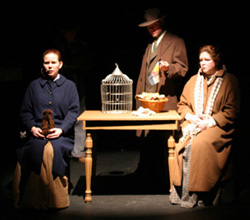
In “Trifles”, Susan Glaspell creates a very “man vs. woman” feel to the play. In this blog, I’m going to explore the different ways in which she creates that feeling and how that relates to the outcome of the story.
Right from the start, as Hale explains how he went to see if the Wrights would want to buy a party telephone with him, Glaspell shows how little women were regarded in this story. Hale says, “but I thought maybe if I went to the house and talked about it before his wife, though I said to Harry that I didn’t know as what his wife wanted made much difference to John—”
Throughout the story, the men were poking fun of the women.
“Well, can you beat the women! Held for murder and worryin’ about her preserves.”
“They wonder if she was going to quilt it or just knot it! [The men laugh, the women look abashed.]”
“Well Henry, at least we found out that she was not going to quilt it. She was going to—what is it you call it, ladies?”
However, what the men failed to realize is that the little things, the “trifles”, that the ladies were discussing and picking up on, actually led to a motive behind the crime. The very things they were making fun of the women about would’ve helped them greatly in actually solving the crime!
First, as much as the men were making fun of the quilt, a good clue to the crime was found there. The women could tell Mrs. Wright had been nervous by her stitching. “Mrs. Peters, look at this one. Here, this is the one she was working on, and look at the sewing! All the rest of it has been so nice and even. And look at this! It’s all over the place! Why, it looks as if she didn’t know what she was about!”
“What do you suppose she was nervous about?”
Secondly, if the men would’ve questioned the birdcage as much as the women and did some investigating on it, they also would’ve had another clue. The women noticed that someone had been rough with the cage door. “Why, look at this door. It’s broke. One hinge is pulled apart.” Then after the women find the bird, which Minnie Wright obviously loved because of the beautiful box it was found in, with its neck wrung, they are able to connect the dots. “[Their eyes meet. A look of growing comprehension, of horror.]”
Now, the women know that Minnie Wright killed her husband, because he killed the bird she so loved. He killed one of the only things that brought her joy. The women now sympathize with Minnie Wright. Because of this and because of how their men regard them, in the end the women decide to protect their own gender and hide Minnie Wright’s motive.