Tuesday, May 3, 2011

Everyday Use


The very first thing that I felt in this story was respect for “Mama”. Even though her education was lacking, she obviously knew how to work. “In real life I am a large, big-boned woman with rough, man-working hands. In the winter I wear flannel nightgowns to bed and overalls during the day. I can kill and clean a hog as mercilessly as a man.”

Dee, on the other hand, did not respect her mother’s work ethic and all her mother had done for her. She seems to only think about everything they are lacking. “No doubt when Dee sees it she will want to tear it down. She wrote me once that no matter where we ‘choose’ to live, she will manage to come see us. But she will never bring her friends.”

Dee’s education didn’t seem to make her a well-rounded person. Instead, it made her more close-minded and arrogant. She thinks she is going back to her history by changing her name, appearance and behavior to those of native Africa. However, she doesn’t realize she’s actually neglecting her real history, a history that is sadly filled with “people that oppress” her. Wouldn’t we all like to just omit the unpleasant things that happened to us? But we can’t. That history makes us stronger if we choose to accept it. Mama has done that, moved on and become a strong woman because of it. Dee doesn’t understand that, and seems to be floating around, trying to give her life purpose. 

Monday, April 18, 2011

A Streetcar Named Desire


Looking back at this play, I see how appropriately named it was! The entire play is focused on the characters' desires and the plot takes us on a little journey through them. 

Stella’s desire is for Stanley, her husband. We get this in the first few lines of the play, when Stanley comes home carrying a package of meat and throws it to Stella. I think the meat symbolizes Stella’s physical desire for Stanley. The play also tells us right after the first line, “Stella comes out on the first floor landing, a gentle young woman, about twenty-five, and of a background obviously quite different from her husband’s”. Using this first clue and many others that follow it, we know that Stella has stepped down in society to be with Stanley and have her “desire”. We get the depth of Stella’s desire for Stanley when she sleeps with him hours, if not minutes, after he aggressively beats her!

Blanche’s desire is easily the most erratic of all in the story. Above all, she desires to be desired. This obsession gets her into huge trouble. Because of her desire, she loses her job, gets chased out of her hometown and has an absolutely filthy reputation. Her reputation is so bad; it even follows her to New Orleans. Her past desires (to be with many men to “help get rid of the loneliness”) cause her to lose her current desire (Mitch). Her desire is so strong, she can’t even learn from her previous mistakes. She still kisses the teenage paper delivery boy, when her previous desires for another teenage boy are what got her fired.

Finally, Stanley’s desires are that of a “red-blooded male”. Williams includes in describing Stanley, “Animal joy in his being is implicit in all his movements and attitudes. Since earliest manhood the center of his life has been pleasure with women, the giving and taking of it, not with weak indulgence, dependently, but with the power and pride of a richly feathered male bird among hens…He sizes women up at a glance, with sexual classifications, crude images flashing into his mind and determining the way he smiles at them”. He even goes so far as to rape Blanche when his wife is in labor! If he was willing to cheat on his wife with her mentally fragile sister, I think it can be assumed that he cheats on a regular basis, consumed by his “red-blooded” desires.

All in all, this story really disgusted me all the way through. The three main characters all acted like animals, having absolutely no sense of reason at all. For me, Stanley raping Blanche at the end was the last straw. 

Monday, April 4, 2011

The Man Who Was Almost a Man


In “The Man Who Was Almost a Man”, Dave is obsessed with becoming a man. This theme is found throughout the entire story from the first paragraph to the last.

“One of these days he was going to get a gun and practice shooting, then they couldn’t talk to him as though he were a little boy.”
“Ah mol enough to hava gun. Ahm seventeen. Almost a man.”
“Shucks. Mistah Joe, Ahm gittin t be a man like anybody else!”
“Ain nothing wrong, Ma. Ahm almos a man now. Ah wans a gun.”
“Lawd, ef Ah had just one mo bullet Ah’d taka shot at tha house. Ah’d like t scare ol man Hawkins jusa little…Jusa enough t let im know Dave Saunders is a man.”
“Ahead the long rails were glinting in the moonlight, stretching away, away to somewhere, somewhere where he could be a man…”


However, for how much Dave proclaims his manhood, his actions do very little to back it up. He acts like more of a child than most seventeen-year-old boys—and that’s quite an accomplishment.

First of all, he’s incredibly insecure. He has a hard time even owning up to his desire for a gun, probably because his reasoning for wanting one is flawed, childish and based around his insecurity.
“Dave looked at the floor, scratched his head, scratched his thigh, and smiled. Then he looked up shyly.”
“When his father and brother had left the kitchen, he still sat and looked again at the guns in the catalogue, longing to muster courage enough to present his case to his mother.”

Secondly, he tends to make a habit of lying & disobeying, then crying when he gets caught.
“He had not come straight home with it as his mother had asked…”
“To avoid surrendering the pistol he had not come into the house until he knew that they were all asleep. When his mother had tiptoed to his bedside late that night and demanded the gun, he had first played possum; then he had told her that the gun was hidden outdoors, that he would bring it to her in the morning.”
“Dave took a deep breath and told the story he knew nobody believed.”
“Then when the point of the plow was stickin up in the air, she swung erroun n twisted herself back on it…She stuck herself n started t bleed. N fo Ah could do anything, she wuz dead.”
“Dave cried, seeing blurred whit and black faces. ‘Ahh ddinn gggo tt sshooot hher…Ah ssswear ffo Gawd Ahh ddin…Ah wuz a-tryin t sssee ef the old gggun would sshoot.’”

Further evidence of his immaturity, he wants his possession to make him a man, instead of earning his way through hard work and good choices.
“One of these days he was going to get a gun and practice shooting, then they couldn’t talk to him as though he were a little boy.”
“In the gray light of dawn he held it loosely, feeling a sense of power. Could kill a man with a gun like this. Kill anybody, black or white. And if he were holding his gun in his hand, nobody could run over him; they would have to respect him.”

Finally, instead of owning up to his mistakes and taking accountability for his actions, Dave blames everyone else and has a pity party.
“N Pa says he’s gonna beat me…He remembered other beatings, and his back quivered. Naw, naw, Ah sho don wan im t beat me tha way no mo. Dam em all! Nobody ever gave him anything. All he did was work. They treat me like a mule, n then they beat me. He gritted his teeth. N Ma had t tell on me.”

In a final act of boyish immaturity, Dave runs away rather than work to right his wrongs.
“Two dollahs a mont. Les see now…Tha means it’ll take bout two years. Shucks! Ah’ll be dam! He started down the road, toward the tracks.” 

Monday, March 28, 2011

Winter Dreams


“Winter Dreams” reminds me a lot of Zitkala Sa’s “Impressions of an Indian Childhood”. Both stories really question our pursuit of the “American Dream”. Dexter and Zitkala Sa both are successful people who have worked hard to earn their way, yet none of this gives them satisfaction or the happiness they are longing for.

Dexter and Judy are young, rich and beautiful. According to our world’s standards, that should make them two very happy people. However, that’s just not the case. Instead, they’re both wandering around blindly in life trying to find happiness.

Judy’s identity is wrapped up in her beauty and ability to get and string along any man she wants. In fact, she strings along multiple men. “He was, as he found before the summer ended, one of a dozen, a varying dozen, who circulated about her. Each of them had at one time been favored above all the others—about half of them still basked in the solace of occasional sentimental revivals. Whenever one showed signs of dropping out through long neglect she granted him a brief honeyed hour which encouraged him to tag along for a year or so longer.” Although Judy is beautiful and pursued, near the end she finally breaks down and admits none of this brings her happiness. “‘I’m more beautiful than anybody else,’ she said brokenly, ‘why can’t I be happy?’”

For all of Dexter’s success, he’s still a very insecure man. He’s worked so hard to get to wear he is, but now he’s not sure where he belongs. On one hand, he’s proud that he’s worked hard to gain his wealth. But on the other hand, he likes to deny his more humble beginnings in an effort to fit into the upper society’s way of life. “He remembered the last time he had seen her father, and found he was glad the parents were not to be here tonight. They would wonder who he was. He had been born in Keeble, a Minnesota village fifty miles farther north and he always gave Keeble as his home instead of Dillard. Country towns were well enough to come from if they weren’t inconveniently in sight and used as footstools by fashionable lakes.” Near the end, Dexter ends up going to war “welcoming the liberation from webs of tangled emotion”.

The story ends with Dexter & Judy still lost and searching for happiness. Dexter finds out Judy’s husband is running around on her, and that she’s no longer considered a “great beauty”. Dexter finally wakes up and realizes that Judy, his ideal woman he’s longed for, is not really an ideal woman at all. “‘Long ago,’ he said, ‘long ago, there was something in me, but now that thing is gone. Now that thing is gone, that thing is gone. I cannot cry. I cannot care. That thing will come back no more.’”

Thursday, March 3, 2011

Oread

The first thing that hit me as I read “Oread” was the imagery involved. I conjured up this image in my mind of an angry sea. A sea to be respected. But as I study this poem, I’m a little confused. I feel like it could be applied to both a sea and a forest. All of the action words, the strong words sound like something that would describe a sea. Words like “whirl”, “splash”, “hurl” “cover” & “pool”.

On the other hand, a lot of the nouns and more subtle words suggested a forest by using words like “pointed pines”, “green” & “fir”. I have a hard time seeing how “pines” and “fir” could have anything to do with a sea. I looked up both words in the dictionary and both almost exclusively dealt with the evergreen tree family. I can see this poem talking about a forest, but it’s still a stretch for imagination. I don’t usually think of a forest as “whirling up”. The only thing I can think of is when pines sometimes lose their needles. This poem could be an angrier take on that. The needles do tend to “splash your great pines on our rocks, hurl your green over us, cover us with your pools of fir”.

Although I hate the fact that I cannot seem to figure this poem out, I love the words in it. Regardless of whether I picture the poem being about a sea or a forest, it gives off this crisp, pristine image of nature. It’s a very beautiful, untamed image.


Tuesday, February 15, 2011

“We call it—knot it, Mr. Henderson.”

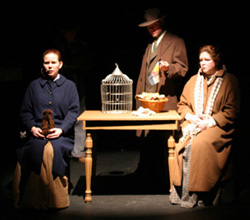
In “Trifles”, Susan Glaspell creates a very “man vs. woman” feel to the play. In this blog, I’m going to explore the different ways in which she creates that feeling and how that relates to the outcome of the story. 

Right from the start, as Hale explains how he went to see if the Wrights would want to buy a party telephone with him, Glaspell shows how little women were regarded in this story. Hale says, “but I thought maybe if I went to the house and talked about it before his wife, though I said to Harry that I didn’t know as what his wife wanted made much difference to John—”

Throughout the story, the men were poking fun of the women.
“Well, can you beat the women! Held for murder and worryin’ about her preserves.”
“They wonder if she was going to quilt it or just knot it! [The men laugh, the women look abashed.]”
“Well Henry, at least we found out that she was not going to quilt it. She was going to—what is it you call it, ladies?”

However, what the men failed to realize is that the little things, the “trifles”, that the ladies were discussing and picking up on, actually led to a motive behind the crime. The very things they were making fun of the women about would’ve helped them greatly in actually solving the crime!

First, as much as the men were making fun of the quilt, a good clue to the crime was found there. The women could tell Mrs. Wright had been nervous by her stitching. “Mrs. Peters, look at this one. Here, this is the one she was working on, and look at the sewing! All the rest of it has been so nice and even. And look at this! It’s all over the place! Why, it looks as if she didn’t know what she was about!”
“What do you suppose she was nervous about?”

Secondly, if the men would’ve questioned the birdcage as much as the women and did some investigating on it, they also would’ve had another clue. The women noticed that someone had been rough with the cage door. “Why, look at this door. It’s broke. One hinge is pulled apart.” Then after the women find the bird, which Minnie Wright obviously loved because of the beautiful box it was found in, with its neck wrung, they are able to connect the dots. “[Their eyes meet. A look of growing comprehension, of horror.]”

Now, the women know that Minnie Wright killed her husband, because he killed the bird she so loved. He killed one of the only things that brought her joy. The women now sympathize with Minnie Wright. Because of this and because of how their men regard them, in the end the women decide to protect their own gender and hide Minnie Wright’s motive.


Monday, January 31, 2011

Roman Fever


One very obvious theme in this story is deception. These two women pretended to be friends throughout their lives, when in reality they had both deceived each other. They weren’t friends at all, but competitors.

I find this aspect of the story sad, because this is all too often what happens in life. From what I’ve seen, “friends” can go through life comparing their lives, keeping track of who has the better family, house, car, clothes, etc. All of this comparing and competition sometimes leads to deception, as it did in “Roman Fever”.

Each woman thought she had the upper hand on the other. Mrs. Slade thought she had the upper hand because she had cleverly crafted (or so she thought) a letter that left Mrs. Ansley out in the cold and away from Mrs. Slade’s own husband-to-be. Mrs. Slade also thought she had the upper hand, because she’s the one who ended up being married to Delphin Slade for 25 years.

Mrs. Ansley thought she had the upper hand because she had a daughter, who was “better” than Mrs. Slade’s daughter, with Delphin Slade. She also thought she had the upper hand because Delphin Slade had written her a letter, telling her to meet him at the Coliseum.

In the end, neither woman’s deception gained her anything. The letter Mrs. Slade crafted to make a fool of Mrs. Ansley came back to “bite her in the butt”, when she found out Mrs. Ansley had written Delphin back and met him at the Coliseum and mothered his daughter Barbara.

Mrs. Ansley suffered a loss when she discovered that Delphin had not actually written the letter inviting her to the Coliseum. By writing back she had, more or less, invited him. I think this makes the meeting at the Coliseum less meaningful for Mrs. Ansley, because it wasn’t Delphin’s idea at all.

Wednesday, January 19, 2011

An Occurrence at Owl Creek Bridge

As I flipped to the page of our assigned reading, I noticed that the title of this story was familiar. I'd read it before in a high school literature class. I remembered being shocked and a little upset when the story ended with Peyton Farquhar's death. Like most of my class, I found myself cheering Farquhar on, only to have my hopes shattered just when the story lead me to believe he would live "happily ever after".

As I began reading this time, knowing how the story would end, I found myself searching for all of the little clues Ambrose Bierce gave us, indicating that the whole escaping adventure was just a delusion. That will be my focus for this post.

The first clue that Farquhar was starting to become delusional is near the end of Part I of the story. He hadn't been hanged yet, but he was waiting for the board beneath his feet to drop. At this time, he heard the ticking of his watch. The story describes it like this:

"Striking through the thought of his dear ones was a sound which he could neither ignore nor understand, a sharp distinct, metal percussion like the stroke of a blacksmith's hammer upon the anvil; it had the same ringing quality. He wondered what it was, and whether immeasurable distant or near by--it seemed both. Its recurrence was regular, but as slow as the tolling of a death knell. He awaited each stroke with impatience and--he knew not why--apprehension. The intervals of silence grew progressively longer; the delays became maddening. With their greater infrequency the sounds increased in strength and sharpness. They hurt his ear like the thrust of a knife; he feared he would shriek." 

As Farquhar slipped away from reality, the story told us he heard each tick of his watch louder than the last to the point of unbearable pain. This is unreasonable and easily a forewarning of the upcoming escape delusion. 

Another clue is given when the story told further evidence of Farquhar's misconception of time. It was probably only a few seconds from the time which the board dropped beneath his feet to the time he felt the pressure from the rope on his throat. However, the story said the time in between seemed to be "ages later", according to Farquhar. 

More clues given all have to do with his "preternaturally keen and alert" physical senses. From seeing the veins on leaves located on distant trees, to hearing a fish part the water with its body as it swam, all of the heightened senses dealing with the environment around him indicated delusion. 

An additional clue is given when Farquhar was "caught in a vortex" in the water, then ended up on the southern bank. That's not very plausible. Once again, it was a sign of delusion. 

The final clue is given at the end, when he was almost home. The story says he'd "fallen asleep while walking". He'd magically gone from being out in the middle of nowhere to being at the gate of his house. This obviously doesn't happen in reality, so it's also a sign of delusion. 

Much like seeing a movie for the second time, picking up on humor and little facets of the plot previously missed, reading this story again helped me make more sense of it. I even found it more enjoyable than the first time.